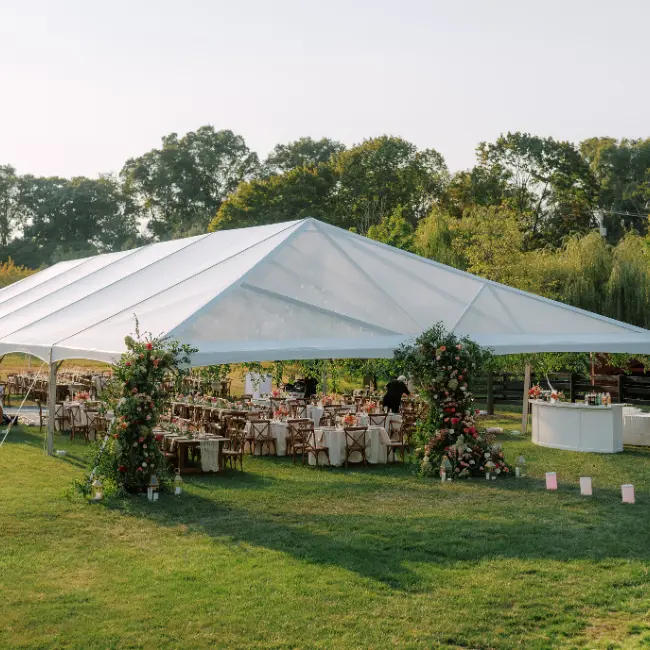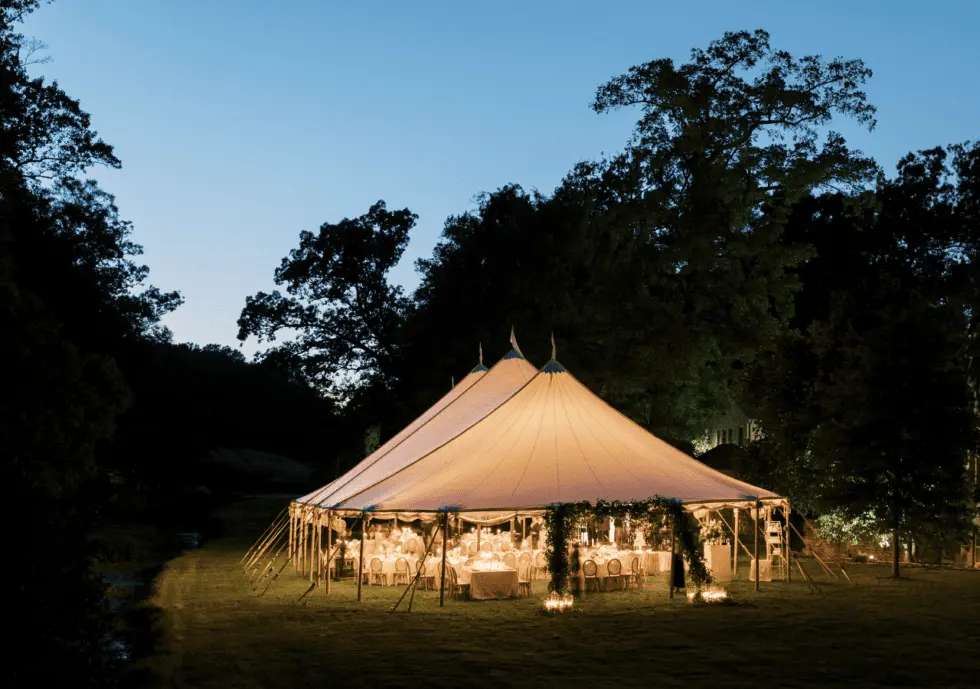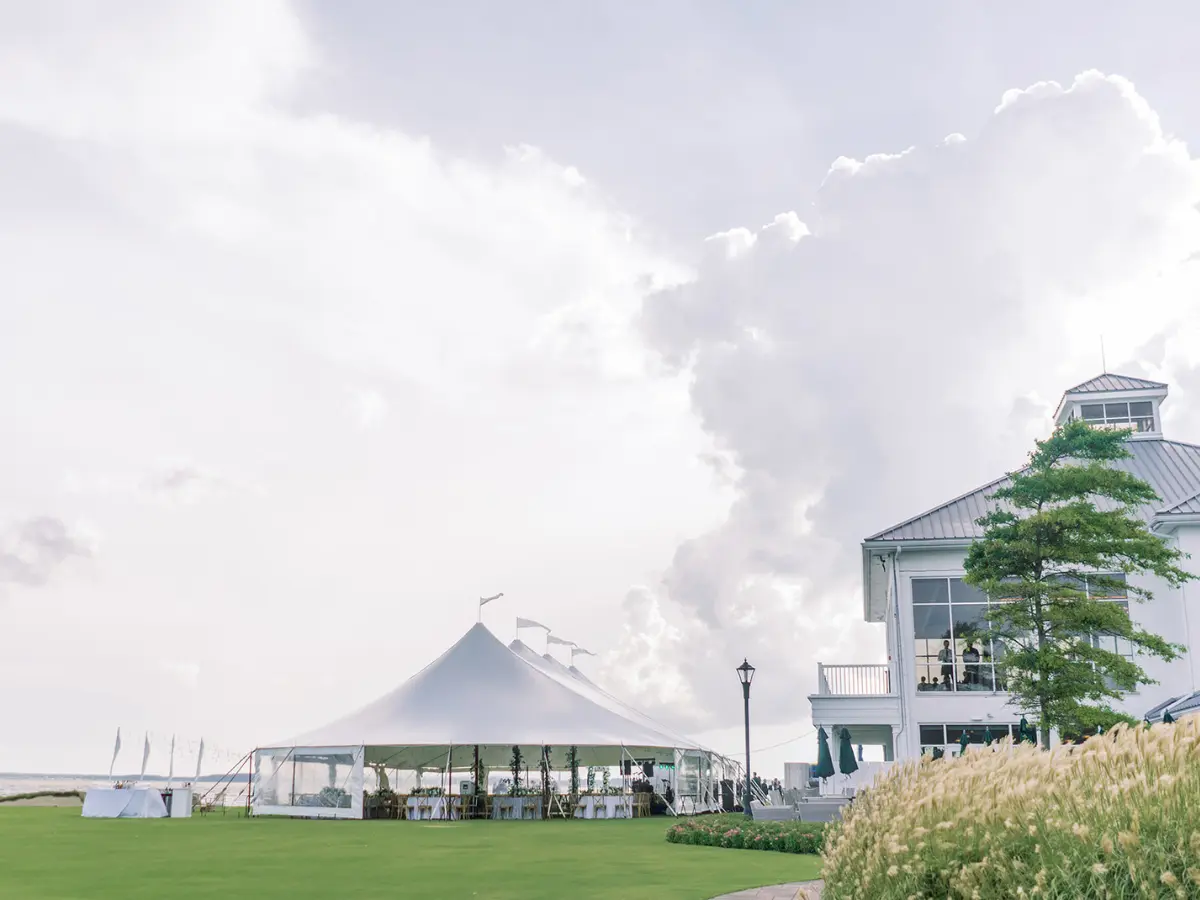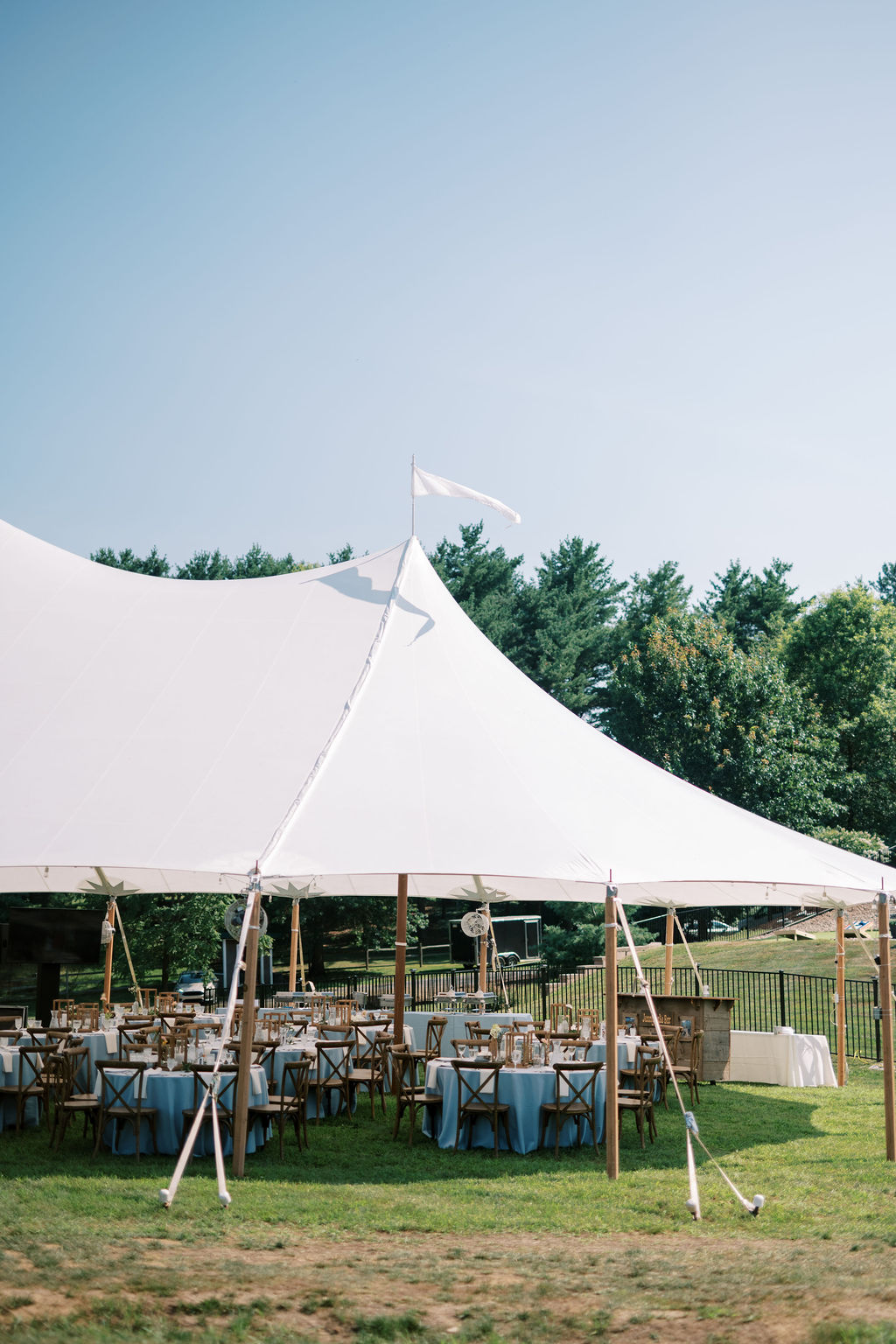
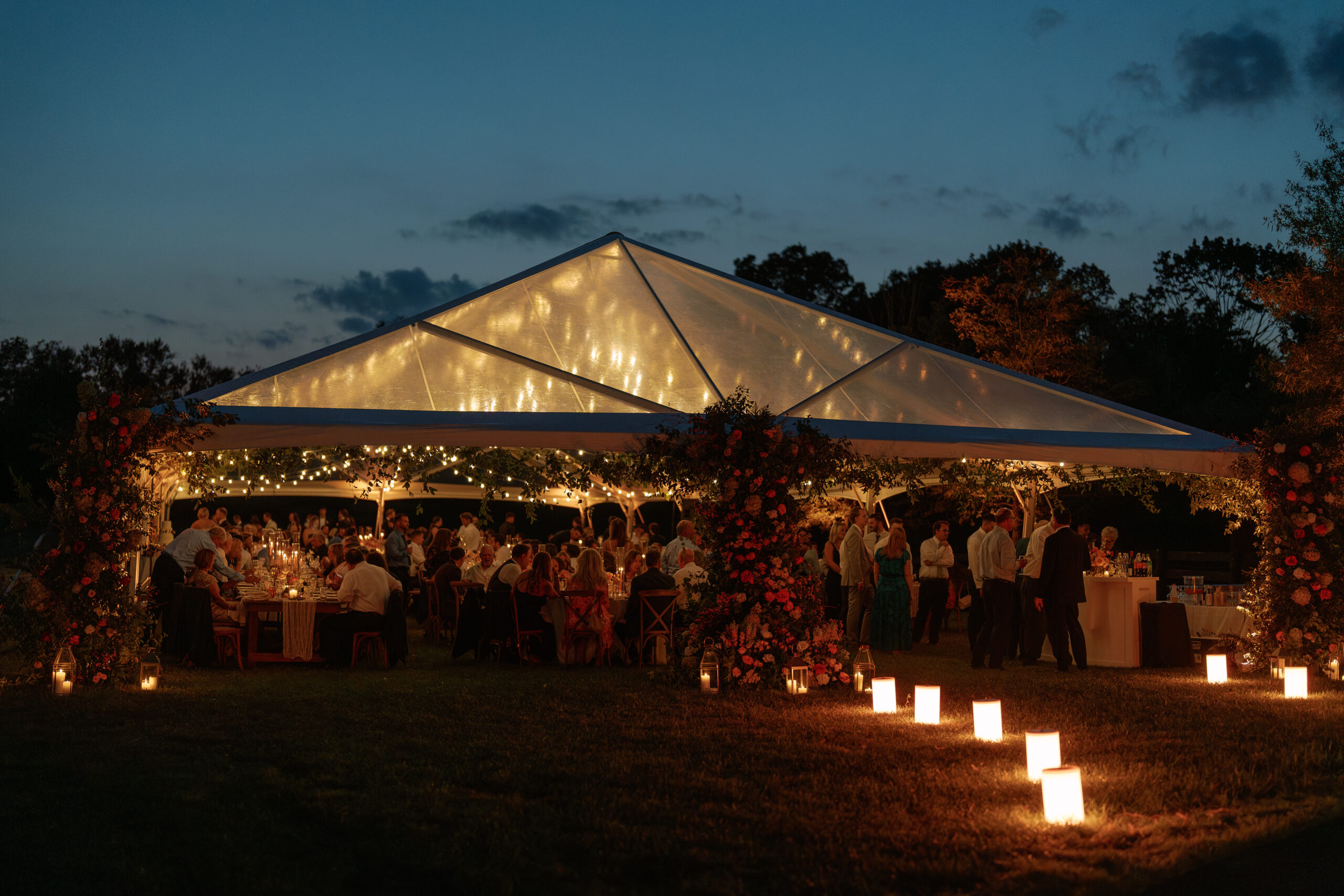
Most tented events use two or three types of lighting rather than one: something across the ceiling to light the space, something around the perimeter so the edges don't fall dark, and often a third that highlights the dance floor or head table.
The right combination depends on the tent, the time of year and how late the event runs. Here's what each type does, and what to think about before you decide.
The five types of lighting, and what each one is for
White café and Tuscan lighting
The workhorse. Bulbs hung along cables strung across the tent give warm, even light across the whole space. If you've pictured a lit tent, you've probably pictured this.
It suits almost everything. It's formal enough for a wedding, relaxed enough for a company picnic, and it doesn't compete with what's happening on the tables. For most events, this is the starting point, and everything else is added around it.
Black Tuscan lighting
The same warm light, with black cord and fittings instead of white.
The difference shows after dark. Against a dark ceiling, the black cord recedes and the bulbs read as points of light hanging in the air. White cord stays visible, so the whole run reads softer and more traditional. Neither is better. It depends on whether you want the fixtures to be part of the look or to disappear.
Swag lighting
Fine strands draped in long curves from the tent peaks toward the edges.
Swag lighting is softer and more decorative than café lighting, with an effect closer to starlight than to bulbs. It's beautiful in a high-peak or sailcloth tent, where the ceiling has shape to follow, and it photographs especially well.
Waterfall lighting
Dense strands running the length of the tent ceiling, close enough together that the ceiling itself becomes the feature.
This is the most dramatic option, and the one guests remember. In a clear-top tent at night, it turns a dark ceiling into a lit one.
Par can lighting
The other four light the space. Par cans shape it.
These directional fixtures wash color up the tent walls, highlight a dance floor, or put light where you want people to look. They set the mood of a room more than they light it, and they're usually paired with one of the string styles rather than used alone.
Paper lanterns are worth considering at the same time. They're decor rather than lighting, but they hang alongside the string runs and change how the whole ceiling reads.
How much lighting does a tent need?
There's no single formula. It depends on the size of the tent, whether the sides are up or down, how late the event runs and what else lights the space around it. What we can tell you is where to start, and why the starting point usually isn't enough on its own.
The minimum is perimeter lighting, fixtures around the edge of the tent. It's the baseline for any tented event that runs past dusk.
On its own, it's rarely enough. Perimeter lighting lights the edges well, but a tent ceiling doesn't reflect much light back down into the space. After dark, the sides stay bright while the middle, where your guests are sitting, stays dim. That's why most events pair perimeter lighting with something across the ceiling: café or Tuscan, swag or waterfall, depending on the look you want.
A few things change the picture:
Tent size. A 20 × 20 lit only at the perimeter can work. A 40 × 80 needs more, because the middle is too far from the edges.
Sides up or down. An open tent borrows light from its surroundings. A tent with sidewalls doesn't, so it needs more inside.
How late it runs. An event that ends at sunset needs less than one that runs to eleven, and in November and December the sun is down before five. If you're planning a holiday party, lighting belongs in the plan from the start. If there's dancing, think about what lights the dance floor once the sun is gone.
What changes with a clear-top tent
Clear top tents are chosen so guests can see the sky, and lighting can work against that if it isn't planned carefully.
Two things are different. There's no fabric ceiling to bounce light off, so fixtures that fill a white tent will read dimmer under a clear top. And bright overhead lighting competes with the view, because stars are hard to see through a lit ceiling.
The usual approach is to keep overhead lighting warm and restrained and let the perimeter and par cans do more of the work. Waterfall lighting is the exception. Under a clear top at night it's spectacular, and it's a deliberate choice to make the ceiling the feature rather than the sky.
Settle the power question early
How much power a tented event needs depends on more than the lighting. Catering equipment, heating and entertainment all draw from the same supply, and what a site can provide often isn't obvious until someone looks.
A venue with outdoor outlets may still not have enough for a full tented event, and a private home usually won't. We own generators and can bring power in where a site needs it, and it's best planned early, because power shapes what's possible, not just what it costs.
This is one of the things a site visit settles. For a site we haven't worked at before, we'll come and take a look. For venues we work at regularly, we often already have layouts drawn and know what works there.
Installation is included
Lighting rentals from Collective Event Group include installation. Our crew hangs it as the tent goes up, so it's finished and tested before anyone arrives. On a week when you have plenty else to do, that's one less thing on your list.
Where to start
If you're working out lighting, you're probably also working out layout: how many tables fit, where the dance floor goes, where people will sit. Those decisions shape each other, so it's easier to make them together.
When you're ready, send us your event details, and we'll put together a quote that includes lighting alongside the tent. If a site visit makes sense, we'll arrange one.